Wednesday, 30 May 2012

Lir (Yr2, S2)


GENERAL SYNOPSIS
‘The Children of Lir’, the classic Irish Fable traditionally tells the story of a family which is split by the tragic death of the mother who dies during child-birth of her two twins. Lir, the father, had then been left with four children. As the children grew the father became more and more lonely and then fell for his dead wife’s sister who was loving and kind at first though once married she became very jealous of the children’s love for their father. As she possessed magical spells she turned against the children and turned them into swans for 900 years.

Today there are many cases that can relate to this. This film can be interpreted in two different ways; by a death or by martial separation.

This short and silent film of this family will be presented in a monographic form through elaborated movement and the emotional expression of the performers.

RELATIONSHIP TO CURRENT STUDIO PROGRESSION
As per my current Artistic Statement, the following mechanisms are brought through the film:
  • Lighting
  • Movement
  • Gesture
  • Camera Angle/Movement
  • Focus
I am using the narrative, chronological structure of this timeless piece to aid my visual language.

INFLUENCES
-Herzog 'Pilgrimage'
-Maya Deren
-Carravaggio
-Welles 'Citizen Kane'
-Bergman 'Persona'
-Lars Von Trier 'Dogville'

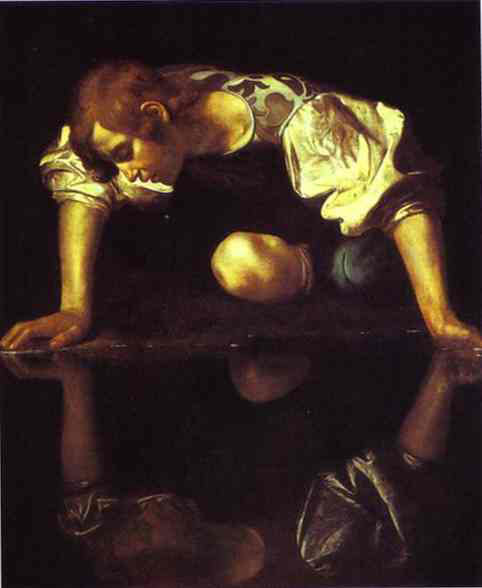
Tuesday, 13 March 2012

Narcissism

Narcissism is becoming increasingly important aspect of my photographic practice. My influence of which comes directly from the story of the God Narcissi which of course, is influenced again from Caravaggio.
nar·cis·sism
/ˈnɑrsəˌsɪzɛm/ [nahr-suh-siz-em]
noun
1. inordinate fascination with oneself; excessive self-love; vanity.
2. Psychoanalysis. Erotic Gratification Derived from admiration of one's own physical or mental attributes, being a normal condition at the infantile level of personality development.


Thursday, 9 February 2012

March 2011 to February 2012 >> Development

Click to view larger - Numbered 1 to 8 left to right
[PLEASE TAKE NOTE: IMAGES DISPLAYED ARE NOT DIRECT THE ORGINAL DIGITAL REPRESENTATION BUT PHOTOGRAPHS OF THE PHOTOGRAPHS, FOR STUDY PURPOSES ONLY]

Over the past year I have broken through into fine art photography and this lens based medium has since become the primary focus of my studio practice. The timeline above features some of the most relevant images that I created that relate primarily to the significance in the development of my ideas and concept.

The Timeline Explained
I have always been very interested in dance, theatre and drama yet also with that a great delight in psychology and the reaction and interaction of the body and its responses to music and emotion. The images above, numbered '1' and '2' were taken in my early studio shoots. In the shoot I am dancing to a choreographed piece. The camera is positioned directly in front of the figure and taken consequetievely every 3 seconds. This released control from my power. The photographs in image '2' were then printed and layed out in a line showing the still imagery in a time lapse.

Ballet is a form of dancing that professionals perfect from a very early age through strenuous training. The beauty of the dance is what we the spectator would see at a ballet performance but what we don't see is the graduation upto that point, the imperfections that occur throughout the training process. In the image '2' we see a selection of images from one particular dance. They are layed out chronoglogically though pick out each step sub-consciously to the dancer in that he is unaware as to when the picture will be taken, pointing out the perfections as well as the imperfections.

Photography '3' shows the influence of man-made and natural objects brought into the frame and how it can influence the body language and emotional response of the model. This was also taken in a raw environment as opposed to the studio. The influence of dance is continued. Other shoots that were taken during this time featured the taking of an external dancer as opposed to self-portraiture; the presentation of these images lay particular importance - for image '3', small photographs from the entire shoot were exhibited and surrounded by the material incorporated into the shoot.

Image '4' brings us to September 2011 where I went back to using the Photography Studio as my main environment. Lighting became very important to me as is focused the voyeur to certain elements of the photograph and also creating an additional emotive to the image. When it came to the camera, technical alterations began to also hold a primary influence. Emphasising the movement in the image and the dance itelf was enhanced by this - leaving the exposure open for a longer period of time allowed me to do this. The faster the model moved the less clear the image would be - this resulted in some beautifully delicate photographs.
The idea of emotional response is clearly evident in photograph '5'. The focus and compositioning of the image along with the lighting highlight the emotion in the image.

I continued along with further emphasis of emotional response and dramatic expression of the model; light direction, positioning, strength and colour; and camera angels, positioning and direction, exposure length and focus.


Monday, 28 November 2011

Caravaggio; A Sub-Conscious Influence


Left: Caravaggio; David with the head of Goliath - Detail (1609-1610)
Right: Eamonn B. Shanahan; Studio Emotive Performance (2011) 

Ultimately I am a huge fan of the great master Caravaggio. His beautiful attention to detail and life-like qualities amaze me. However when I was shooting my Performance Art Work, I had not intended to have a Caravaggio-like relation attached to my work.

This acknowledgement came to me in a lecture on Caravaggio by Vera Ryan on Monday 21st November 2011 and also from comments and observations from my colleagues. However in the lecture Vera Ryan spoke about the early works of Caravaggio in which the master created self-portraits, moreover she stated that there was an 'irrelevance of time and space' in these early paintings. Currently, as my work is based in an environment that is neutral, I would like to believe that this influence has much duplication from Caravaggio though in the medium of photography.

Furthermore in the continuation of my studio work I hope to develop the irrelevance of time and space and push it to its limits incorporating my own response to movement and emotive response.


Tuesday, 1 November 2011

Mystical World - Thoughts


A place where the bees do not sting and the lions do not roar; where one can carelessly walk through nature. No fear. No stress. No time constraints. A beautiful place where dreams can wonder. The colours of dusk glisten in the air; brilliant blues and starry whites enchant the visitor. The sound of sweet magical music flows gently within the very soul.

EAMONN SHANAHAN